
1
Define role-fit evidence
Name the project types, ownership clues, stack context, and validation questions that matter for the role.

Resume keywords are easy to search, but they are a thin proxy for engineering ability. Developer hiring works better when recruiters use visible work, portfolio depth, and structured role-fit notes to decide who deserves the next step.
What this page helps answer
Put this guide to work
The point of GitHub-first review is not more browsing. It is a better first-pass standard that recruiters and hiring managers can use consistently.
Name the project types, ownership clues, stack context, and validation questions that matter for the role.
Use repositories, portfolios, contribution history, and project framing to understand real engineering context.
Let resumes add career history after visible work has already shaped the shortlist decision.
In the product
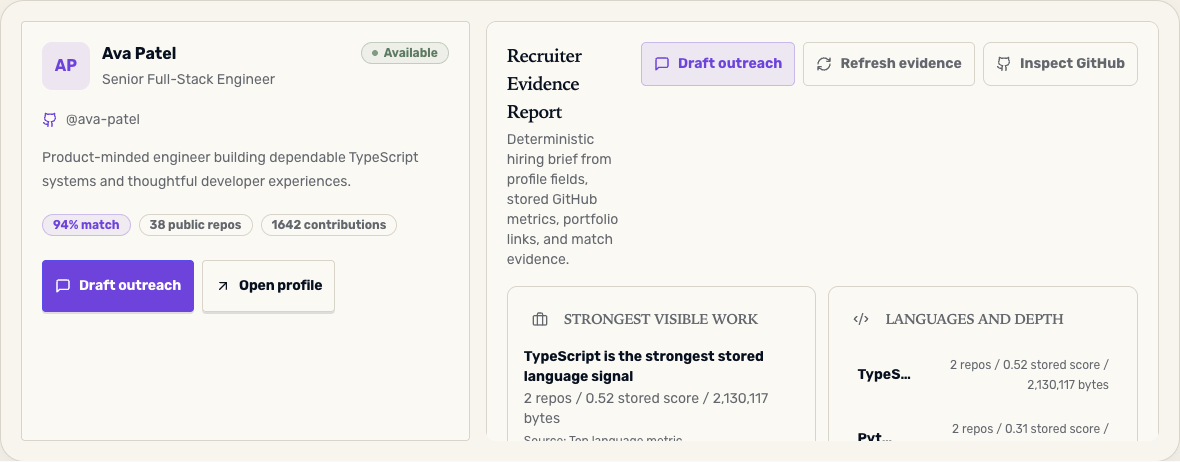
The goal is to keep enough role-fit, work-sample, and screening context visible that the next decision is grounded in evidence instead of resume shorthand.
Keyword screens are convenient because they are fast. The problem is that they reward familiar wording, profile polish, and exact-match phrasing more than demonstrated engineering ability.
Strong developers may describe their work differently, move across adjacent stacks, or have public projects that show more relevance than their resume summary. If keywords lead every decision, those candidates are easy to miss.
A stronger workflow starts with role-fit evidence. Recruiters can review public repositories, portfolio projects, contribution recency, and documentation to understand whether a candidate has built work that resembles the role.
This does not remove resumes from the process. It changes their job. The resume becomes career context after visible work has already helped identify who deserves deeper review.
Non-keyword screening still needs structure. Use a simple rubric for role fit, project substance, recency, ownership, and communication. Review a few representative work samples, then write concise notes.
The output should be a better shortlist, not an endless research task. Recruiters should know why a candidate advanced and what the next screen needs to validate.
Recruiter next step
GitTalent helps recruiter teams keep technical context attached to sourcing, screening, outreach, and evaluation instead of losing it across disconnected tools.