
1
Choose representative work
Review two or three projects that best match the open role instead of scanning every link equally.

A developer portfolio can be useful only if recruiters know what to look for. This checklist keeps the review focused on project depth, role relevance, contribution recency, and ownership evidence instead of surface polish alone.
What this page helps answer
Put this guide to work
The point of GitHub-first review is not more browsing. It is a better first-pass standard that recruiters and hiring managers can use consistently.
Review two or three projects that best match the open role instead of scanning every link equally.
Look at role fit, project depth, recency, ownership, and communication quality with a repeatable checklist.
Use portfolio observations to decide what to ask in recruiter screens, assessments, or hiring-manager review.
In the product
The goal is to keep enough role-fit, work-sample, and screening context visible that the next decision is grounded in evidence instead of resume shorthand.
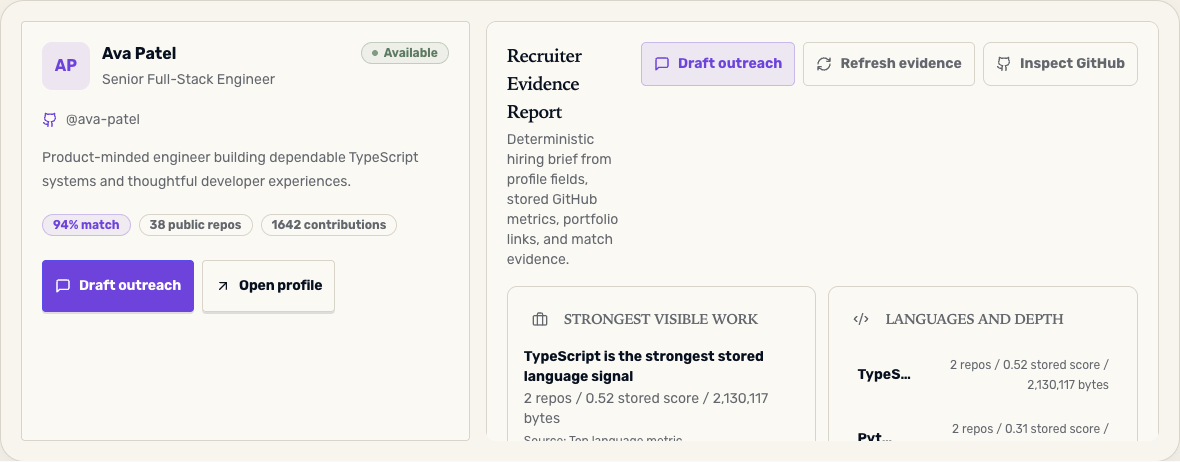
Start with relevance. A portfolio can include many projects, but the recruiter review should begin with work that maps most closely to the job. The goal is to understand whether the candidate has built things that resemble the role you are hiring for.
From there, look at project framing, links to public repositories, contribution recency, and signs that the candidate owned meaningful implementation decisions.
A polished portfolio is helpful, but polish is not the same as engineering evidence. Recruiters should look for implementation depth, maintenance behavior, tradeoff explanations, and signs that the work solved a real problem.
The strongest portfolios make it easy to understand what the developer built, why it mattered, which parts they owned, and what technical decisions shaped the result.
The output of portfolio screening should be a short, useful note. Capture what looked relevant, what evidence supports that view, and which question should be answered next. That keeps the review practical instead of subjective.
A good note might mention that the candidate has recent full-stack work, a maintained backend project, or strong communication in project documentation. Those details help the hiring manager understand why the candidate advanced.
Recruiter next step
GitTalent helps recruiter teams keep technical context attached to sourcing, screening, outreach, and evaluation instead of losing it across disconnected tools.