
1
Identify relevant projects
Start with repositories or contributions that map to the stack, domain, or ownership level of the role.

Open source work can be a strong hiring signal, but it needs careful interpretation. Recruiters should look beyond stars and follower counts to understand contribution depth, project relevance, maintenance behavior, and whether the work maps to the role.
What this page helps answer
Put this guide to work
The point of GitHub-first review is not more browsing. It is a better first-pass standard that recruiters and hiring managers can use consistently.
Start with repositories or contributions that map to the stack, domain, or ownership level of the role.
Look at pull requests, issues, commits, documentation, and maintenance patterns before relying on popularity.
Use the visible work to ask better follow-up questions in recruiter screens or technical interviews.
In the product
The goal is to keep enough role-fit, work-sample, and screening context visible that the next decision is grounded in evidence instead of resume shorthand.
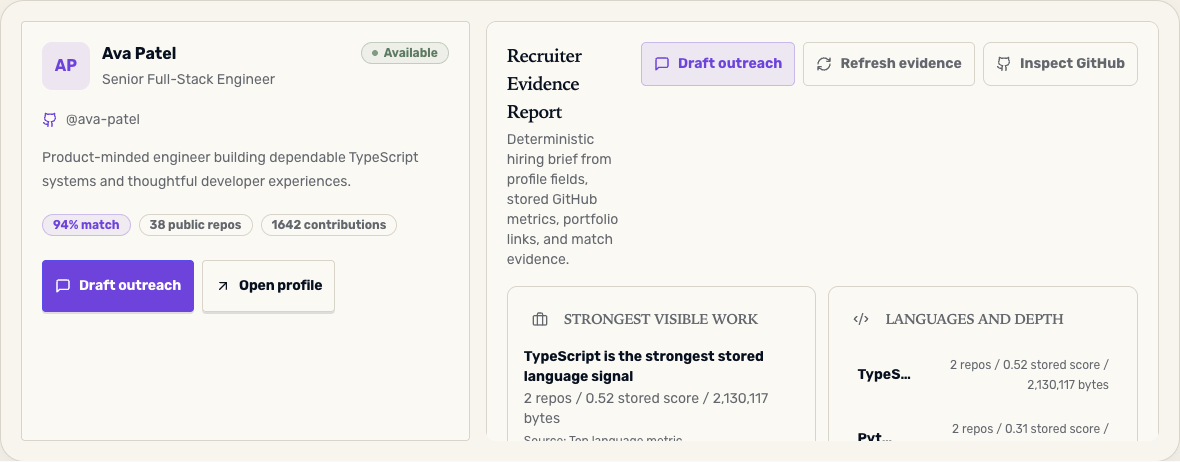
Stars, forks, and follower counts are easy to compare, but they are not enough to evaluate a developer. Popularity can reflect timing, community interest, or project marketing more than the candidate’s day-to-day engineering fit.
The better question is whether the open source work shows relevant problem solving. A smaller contribution to a project close to your stack may matter more than a visible project that has little connection to the role.
Strong evidence can appear in maintained repositories, meaningful pull requests, issue discussion, release work, documentation, or architecture decisions. Recruiters do not need to judge every line of code to recognize useful hiring context.
The goal is to understand how the developer contributes. Did they fix real problems, communicate tradeoffs, maintain a project over time, or collaborate in a way that maps to your team’s environment?
Open source review becomes useful when it informs the next step. Capture a few specific observations and convert them into validation questions. That keeps the process evidence-based without asking recruiters to run a full technical interview.
For example, a recruiter note might mention a relevant library contribution, a maintained backend service, or strong documentation. The next screen can then validate ownership, impact, and technical tradeoffs.
Recruiter next step
GitTalent helps recruiter teams keep technical context attached to sourcing, screening, outreach, and evaluation instead of losing it across disconnected tools.