
1
Use LinkedIn for career context
Review titles, company history, and availability clues without treating profile keywords as technical proof.

LinkedIn is useful for career history and contact discovery, but it often leaves recruiter teams guessing about technical depth. GitHub recruiting adds a different kind of context: public projects, contribution patterns, and visible work that can improve the shortlist before outreach starts.
What this page helps answer
Put this guide to work
The point of GitHub-first review is not more browsing. It is a better first-pass standard that recruiters and hiring managers can use consistently.
Review titles, company history, and availability clues without treating profile keywords as technical proof.
Open relevant repositories, activity, and project framing to understand whether the work maps to the role.
Send better-informed recruiter notes because the shortlist is based on both career fit and visible technical substance.
In the product
The goal is to keep enough role-fit, work-sample, and screening context visible that the next decision is grounded in evidence instead of resume shorthand.
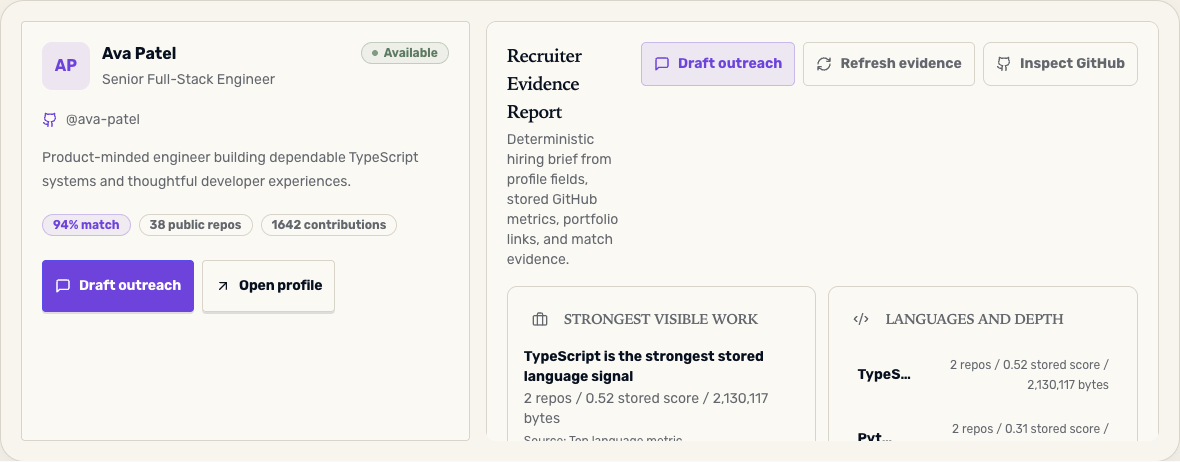
LinkedIn is good at showing a professional timeline. Recruiters can see company history, titles, location, and high-level skills quickly. That makes it useful for finding people who may fit a role on paper.
The weakness is that much of the technical evidence is still self-described. A profile can say React, Python, platform engineering, or open source without showing what the person actually built, maintained, or owned.
GitHub recruiting gives teams a way to review public work before deciding who deserves outreach. Repositories, readmes, commits, issues, and contribution recency can reveal practical engineering context that a profile summary cannot carry.
That does not mean every good developer has a perfect public footprint. It means that when public work exists, recruiters can use it to sharpen role-fit decisions instead of relying only on profile wording.
If the hiring problem is contact discovery, LinkedIn may lead. If the problem is shortlist quality for software roles, GitHub evidence should move earlier in the workflow. The key is matching the source to the decision you are making.
A practical process starts with role criteria, reviews public work where available, then uses LinkedIn and resumes to add career context. That sequence keeps technical evidence from becoming an afterthought.
Recruiter next step
GitTalent helps recruiter teams keep technical context attached to sourcing, screening, outreach, and evaluation instead of losing it across disconnected tools.