
1
Start with relevant repositories
Review two or three repositories that look closest to the role instead of trying to audit everything.

If you want a stronger first pass on engineering candidates, start with the public work developers have already shipped. GitHub profiles give recruiter teams a way to inspect project depth, recency, and ownership signal before spending more hiring-manager time.
What this page helps answer
Put this guide to work
The point of GitHub-first review is not more browsing. It is a better first-pass standard that recruiters and hiring managers can use consistently.
Review two or three repositories that look closest to the role instead of trying to audit everything.
Record short observations about stack relevance, project depth, and ownership so hiring managers inherit useful context.
Move the strongest candidates into recruiter screen or assessment because of visible work, not just resume wording.
In the product
The goal is to keep enough role-fit, work-sample, and screening context visible that the next decision is grounded in evidence instead of resume shorthand.
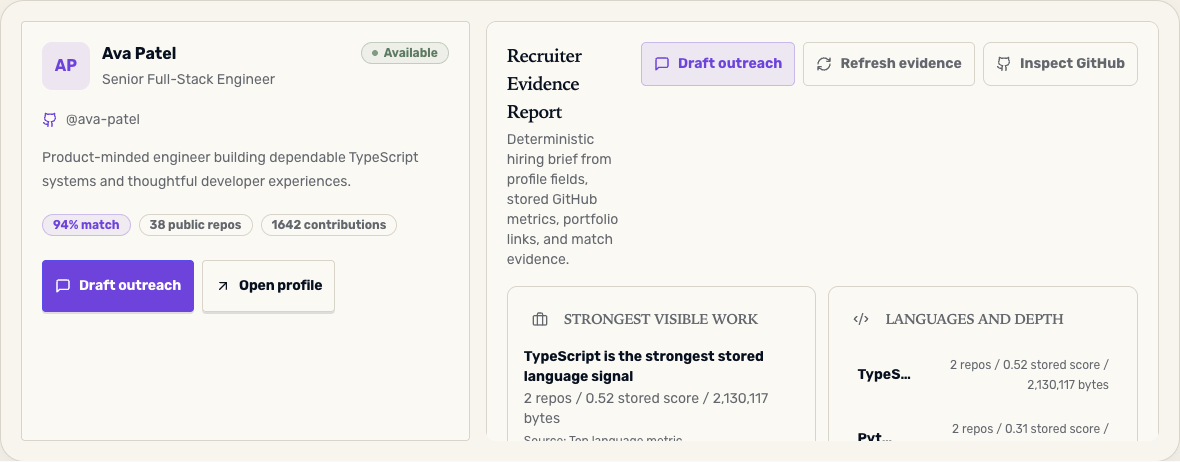
Resumes are fast to scan, but they compress technical ability into short claims that are easy to over-interpret. A GitHub profile lets recruiter teams see what a candidate has actually built, maintained, and contributed to in public.
That does not replace every later stage. It gives you a better starting point. Instead of asking who wrote the cleanest resume summary, you can ask which candidates show work that looks closest to the role you need to fill.
Start with repository selection and role fit. If you are hiring for backend work, open the repositories that most clearly show backend ownership. If you are hiring for product engineering, look for full-stack evidence, shipped interfaces, and maintenance work.
Then look for signs of substance: meaningful readmes, clear project framing, sustained commits, and work that appears to solve a real problem instead of serving as a one-off tutorial clone.
The fastest way to make this useful is to define a repeatable review standard. Decide which signals matter for the role, review a small set of representative repositories, and save short notes that hiring managers can reuse.
That keeps GitHub review from becoming unstructured research. Recruiters move faster, managers receive better context, and candidates are advanced because of relevant technical evidence instead of generic keyword matches.
Recruiter next step
GitTalent helps recruiter teams keep technical context attached to sourcing, screening, outreach, and evaluation instead of losing it across disconnected tools.