
1
Open the most relevant repositories first
Prioritize the work that best maps to the role instead of scrolling through the entire profile.

Evaluating developers on GitHub is not about judging who has the biggest public footprint. It is about inspecting the kind of work a candidate has shipped and deciding whether that evidence looks relevant to your hiring context.
What this page helps answer
Put this guide to work
The point of GitHub-first review is not more browsing. It is a better first-pass standard that recruiters and hiring managers can use consistently.
Prioritize the work that best maps to the role instead of scrolling through the entire profile.
Inspect project framing, maintenance, technical choices, and ownership clues before reacting to stars or follower counts.
Use a simple rubric so recruiter notes clearly explain why a candidate should advance or not.
In the product
The goal is to keep enough role-fit, work-sample, and screening context visible that the next decision is grounded in evidence instead of resume shorthand.
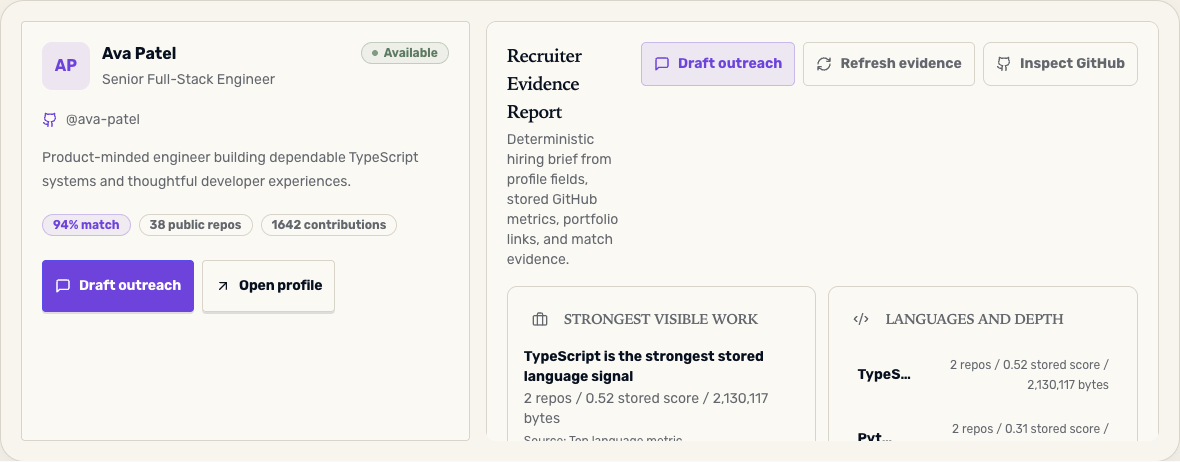
A useful GitHub evaluation begins with the job you are trying to fill. The question is not whether the candidate has an impressive profile in the abstract. It is whether the visible work suggests they can do the kind of engineering your team needs.
That is why role-fit should come first. A modest but highly relevant repository can matter more than a popular project that has little to do with your open role.
Strong evidence usually shows up in project depth, code organization, maintenance behavior, and signs that the candidate can frame and ship technical work clearly. A repository does not need to be perfect to be informative.
You are looking for enough signal to understand how the developer works. That might appear in architecture decisions, readmes, commit patterns, issue handling, or the clarity of the project itself.
A rubric keeps GitHub review consistent across the team. Score or note the same few dimensions each time: role-fit, project substance, recency, and ownership. The goal is not perfect precision. It is consistent reasoning.
That consistency makes recruiter notes more useful for hiring managers and helps prevent the process from drifting into personal preference or vanity-metric bias.
Recruiter next step
GitTalent helps recruiter teams keep technical context attached to sourcing, screening, outreach, and evaluation instead of losing it across disconnected tools.