
1
Check role alignment
Compare the candidate’s visible work and background against the role’s stack, domain, and ownership needs.

A software engineer screening checklist should help recruiters make consistent early decisions. The useful version focuses on role fit, public work, ownership clues, communication, and what should be validated next.
What this page helps answer
Put this guide to work
The point of GitHub-first review is not more browsing. It is a better first-pass standard that recruiters and hiring managers can use consistently.
Compare the candidate’s visible work and background against the role’s stack, domain, and ownership needs.
Look at representative repositories, portfolio projects, documentation, recency, and contribution depth.
Write down what should be confirmed through recruiter screen, hiring-manager review, or technical assessment.
In the product
The goal is to keep enough role-fit, work-sample, and screening context visible that the next decision is grounded in evidence instead of resume shorthand.
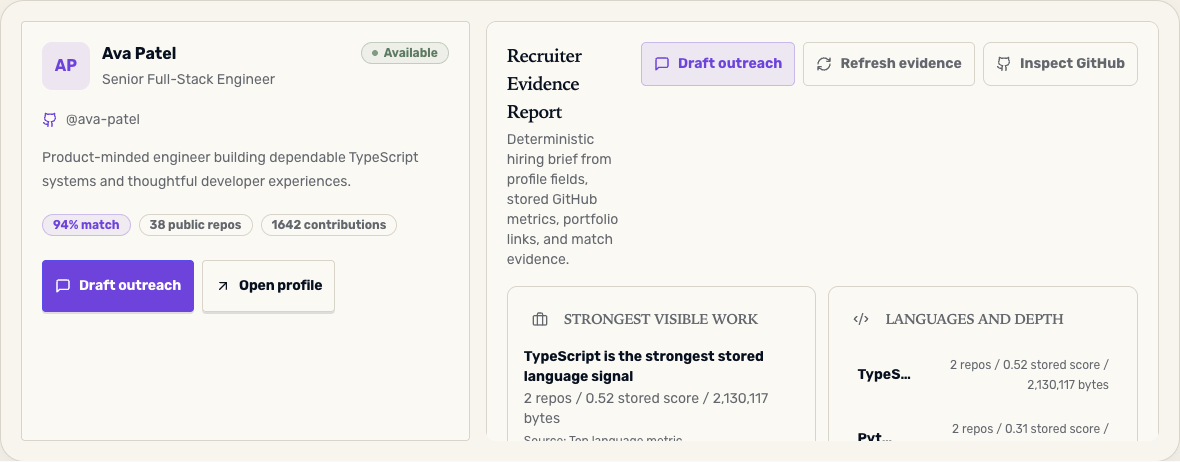
A useful software engineer screen captures the same core signals each time: role fit, work evidence, ownership, communication, and open questions. That keeps review consistent without turning recruiters into technical interviewers.
The goal is to decide who deserves more time and why. A checklist should make that decision clearer for both recruiters and hiring managers.
Public work is most useful when the review is narrow. Choose the projects that best match the role, then inspect project depth, recency, and how clearly the candidate explains the work.
Recruiters do not need to audit every implementation detail. They need enough context to understand whether the candidate has relevant evidence and what the hiring team should validate next.
The checklist should end with a concise recommendation. Explain why the candidate advances, which evidence supports that view, and which question remains open.
That gives hiring managers a better starting point than a forwarded resume. It also helps recruiting teams compare candidates with the same standard instead of relying on memory or preference.
Recruiter next step
GitTalent helps recruiter teams keep technical context attached to sourcing, screening, outreach, and evaluation instead of losing it across disconnected tools.