
1
Search from role requirements
Start with stack, domain, ownership level, and project type so public-code review stays focused.

Public code gives recruiter teams a way to source developers with technical context already in view. Instead of starting only from keyword matches, recruiters can review repository relevance, project depth, and contribution recency before deciding who deserves outreach.
What this page helps answer
Put this guide to work
The point of GitHub-first review is not more browsing. It is a better first-pass standard that recruiters and hiring managers can use consistently.
Start with stack, domain, ownership level, and project type so public-code review stays focused.
Review representative repositories or portfolio projects that show whether the candidate fits the role.
Use the visible work to write better recruiter notes and more relevant candidate messages.
In the product
The goal is to keep enough role-fit, work-sample, and screening context visible that the next decision is grounded in evidence instead of resume shorthand.
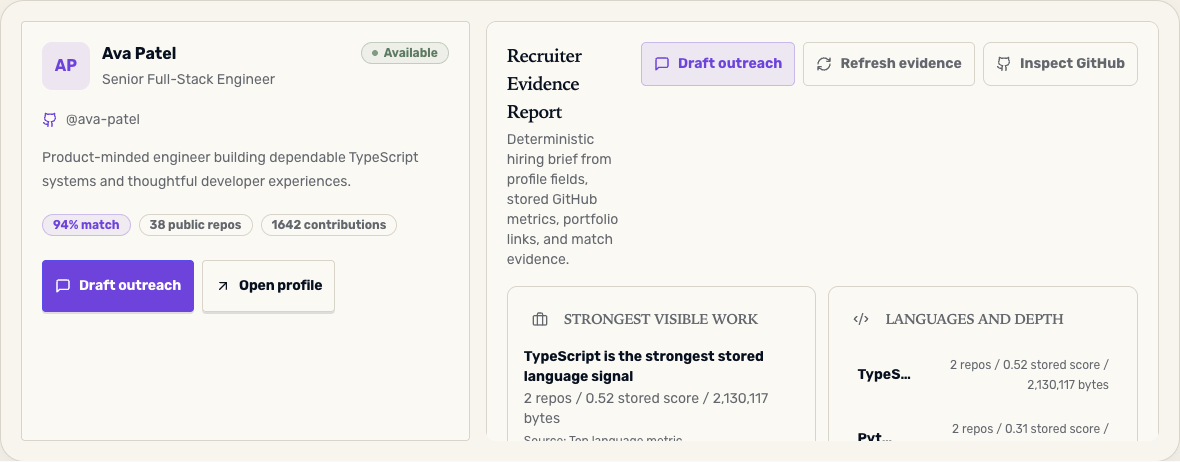
Traditional sourcing often starts with resumes, job titles, and skill keywords. Those signals are convenient, but they do not always show how someone builds. Public code gives recruiters a different starting point: work that can be inspected before outreach.
That can reduce noise in the shortlist. Recruiters can see whether the candidate has relevant projects, recent activity, and technical context that aligns with the role.
Start with the work closest to the role. If you are hiring for backend systems, look for backend projects, API work, data modeling, infrastructure, or relevant maintenance. If you are hiring product engineers, look for shipped interfaces and full-stack context.
Then check for substance: clear project framing, signs of ownership, meaningful commits, and evidence that the developer can follow through beyond a small demo.
Public-code sourcing should not become open-ended browsing. Use a simple rubric, review a limited number of representative work samples, and write down why the candidate fits or does not fit.
The practical output is a better shortlist and a better outreach message. Recruiters can reference specific work, and hiring managers inherit the context that made the candidate worth a closer look.
Recruiter next step
GitTalent helps recruiter teams keep technical context attached to sourcing, screening, outreach, and evaluation instead of losing it across disconnected tools.