
1
Capture visible work first
Start with public repositories, portfolio projects, and contribution context before asking tests to carry every decision.

Technical screening tools should help recruiters make better early decisions, not just add another step. The useful tools preserve visible work, role-fit observations, and evaluation context so hiring managers receive more than a forwarded resume.
What this page helps answer
Put this guide to work
The point of GitHub-first review is not more browsing. It is a better first-pass standard that recruiters and hiring managers can use consistently.
Start with public repositories, portfolio projects, and contribution context before asking tests to carry every decision.
Use coding tests or deeper screens after the initial work-sample review has clarified what to validate.
Pass forward notes that explain project relevance, concerns, and why the candidate deserves the next step.
In the product
The goal is to keep enough role-fit, work-sample, and screening context visible that the next decision is grounded in evidence instead of resume shorthand.
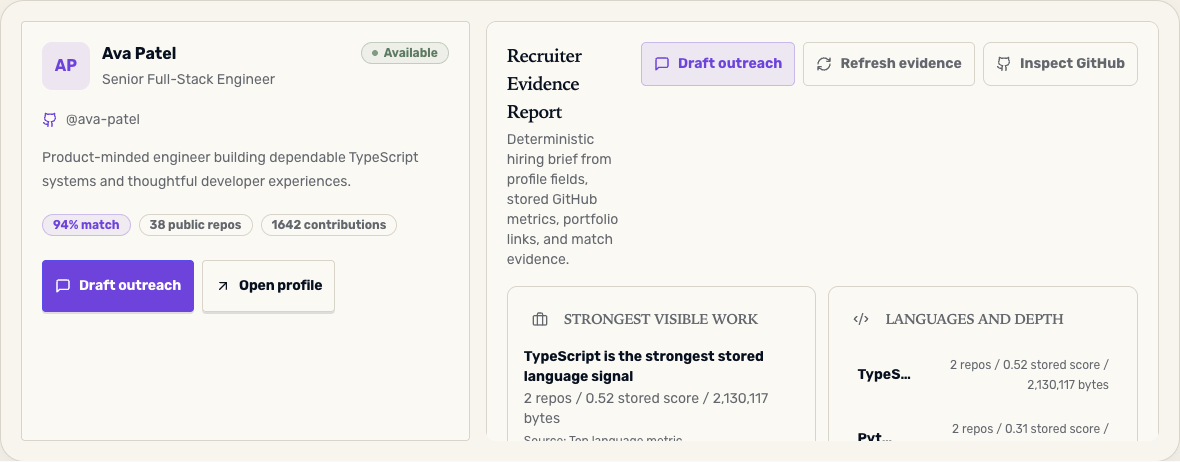
Recruiters do not need a tool that only produces a score without context. They need a workflow that helps them understand why a candidate looks relevant, what evidence supports that view, and what should be validated next.
That means technical screening should include visible work, structured notes, and a path into assessment. The best tools reduce guesswork instead of turning the process into another disconnected dashboard.
When sourcing, notes, messages, and tests live in separate products, the recruiter has to rebuild context at every stage. The original reason a candidate looked promising can disappear before the hiring manager sees the profile.
That creates weaker decisions and more manual work. A technical screening tool should keep the evidence close to the candidate so the next step is easier to defend.
Before choosing a tool, map the decision it improves. If it only helps after a candidate is already deep in process, it may not solve the shortlist problem. If it preserves visible work and connects it to assessment, it can improve both speed and quality.
Recruiters should look for tools that make the first pass more evidence-based, keep notes attached, and create a clear bridge into structured validation.
Recruiter next step
GitTalent helps recruiter teams keep technical context attached to sourcing, screening, outreach, and evaluation instead of losing it across disconnected tools.